
What Does a COO Actually Do? A Plain-English Job Description
The chief operating officer role in plain English: what a COO owns, what a week in the seat looks like, and when you need one.

In this post
01
The one-sentence version
A chief operating officer turns the founder's vision into a business that runs without the founder holding it up.
Every formal definition says some version of "oversees day-to-day operations." True, and almost useless, because it doesn't tell you what that feels like from the inside. Here's the version I use: the CEO decides where the business is going. The COO makes sure it actually gets there, on Tuesday, with the people and tools it has, whether or not the CEO is in the room.
If the CEO is the one holding the map, the COO is the one who packs the vehicle, assigns the seats, checks the tires, and makes sure everyone arrives together.
02
What a chief operating officer actually owns
The details change with the company. The shape of the job doesn't. A COO owns six things:
- How work moves. The path from a new lead to a delivered result, and every handoff in between.
- Who owns what. Clear roles and decision rights, so questions don't all route to one person.
- The numbers that say whether it's working. A small set of metrics reviewed on a steady rhythm, not a dashboard nobody opens.
- The tools underneath. The software, automations, and documentation the team actually runs on.
- The weekly rhythm. Meetings, reviews, and checkpoints that turn quarterly goals into Tuesday's work.
- The people side of scale. Defining roles before hiring, onboarding well, and fixing structure before blaming individuals.
Notice that none of those are "do the work." A COO who personally does everything has become a very expensive bottleneck. The job is to build the structure other people do the work inside.
03
What a week in the seat looks like
Titles are abstract. Calendars aren't. A realistic week for a COO in a growing service business looks something like this:
- Monday: a short leadership meeting. Last week's numbers, this week's three priorities, and who owns each one.
- Tuesday and Wednesday: building. Rewriting an onboarding process that keeps dropping clients, or scoping a role before it gets hired.
- Thursday: unblocking. Clearing decisions that are stuck, and noticing which ones keep getting stuck in the same place.
- Friday: closing the loop. What shipped, what slipped, and what the slip is telling you about the system.

The rhythm is the product. A team that knows exactly when decisions get made stops interrupting to ask for them.
04
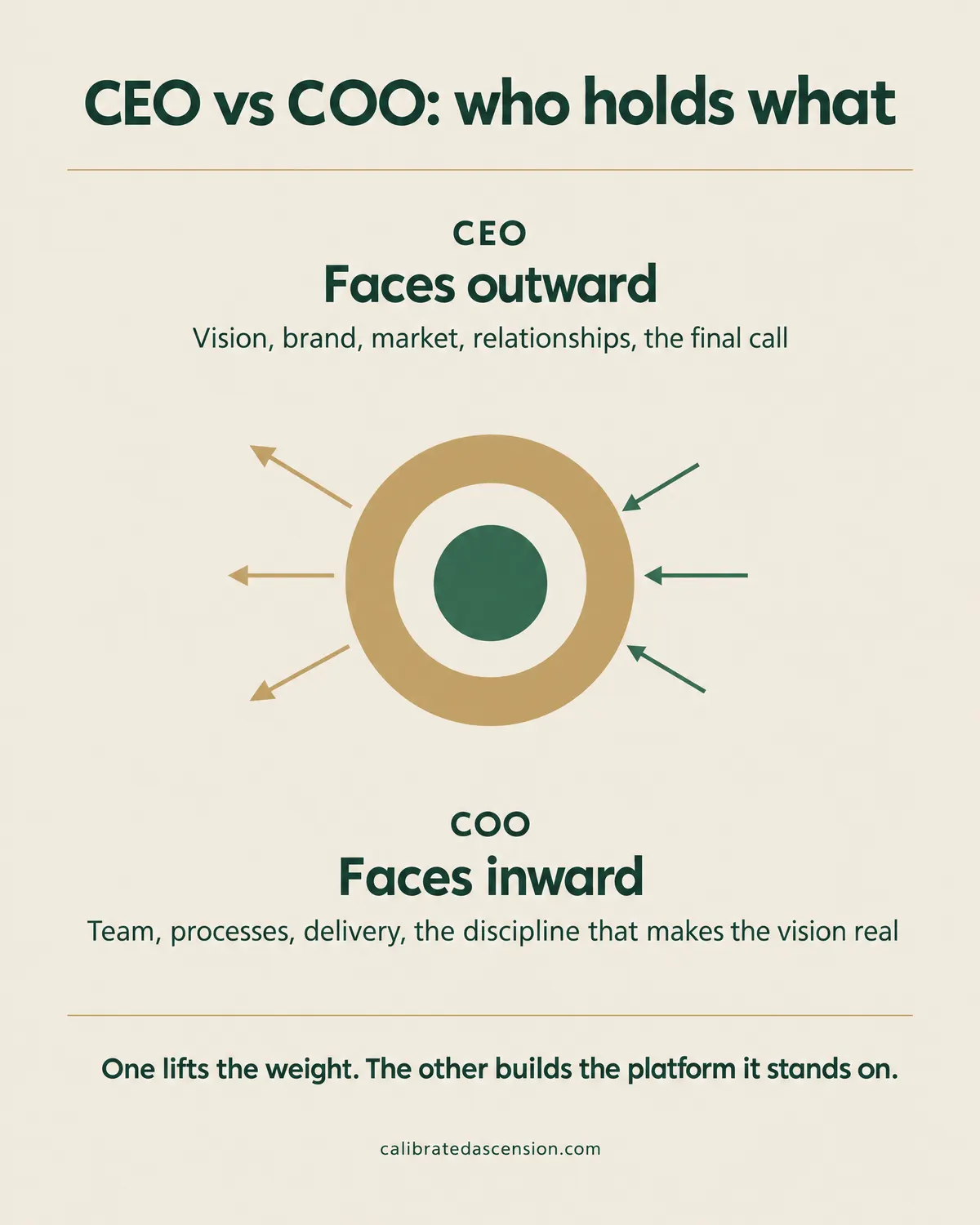
CEO vs COO: who holds what
The simplest split: the CEO faces outward and the COO faces inward. The CEO holds the vision, the brand, the market, the big relationships, and the final call on direction. The COO holds the team, the processes, the delivery, and the discipline that makes the vision real.
In founder-led businesses, especially expert-led ones like coaching and consulting, the founder is usually the product, the marketer, and the operator at once. That's the exact moment COO-level thinking starts paying for itself.
05
What a COO is not
A few roles get confused with the COO seat. They're all valuable. They're just different jobs.
- Not an assistant. An assistant manages your time. A COO manages the business's time.
- Not a project manager. A PM runs a project inside the system. A COO designs the system the projects run in.
- Not a CFO. The CFO reads what the money is doing. The COO builds the engine that produces it. More on that in fractional COO vs CFO.
- Not a second founder. A COO serves the vision. If they start rewriting it, you have a different conversation to have.
What a COO does in a small service business
Most articles about the COO role are written for large companies. In a coaching, consulting, or agency business with a handful of people, the job looks more intimate. The COO is usually the first person who sees the whole business at once, other than the founder.
The first thing I look at is the founder's calendar. When a founder tells me they don't have time, I don't argue.
I ask to see the last two weeks of their calendar, and sometimes their screen time. The evidence does the work an argument never could, and it shows exactly which decisions have no owner but them.
The second thing is visibility. I build dashboards so bottlenecks are visible instead of personal. When a stuck task sits on a shared board, it's a system problem everyone can see and fix.
When it lives in someone's head, it turns into frustration with a person. The full list of what gets checked first is in the operations audit checklist.
Full time, fractional, or not yet
A full-time COO is a serious hire: $150,000 to $350,000 or more a year in salary before equity and benefits. For a large team with complex operations, that's the right call.
Most growing service businesses need the thinking long before they need the full-time seat. That's where a fractional COO fits: the same role, part time, usually brought in to design and install the operating system, then hand it to the team.
Monthly retainers in the market typically run $3,000 to $10,000. The full breakdown is in what a fractional COO actually does.
And sometimes the honest answer is not yet. If your offers are still scattered, a COO will help you run the scatter very efficiently. Get the direction clear first, then build the machine.
The real job
Strip away the title and the org chart and a COO does one thing: makes the business steady enough that the vision can survive contact with real life. Clients get the same experience on your worst week as your best one.
Your team knows what to do without asking. You can step away for a few days and come back to a business that kept its shape.
That's what the founder's vision needs to become real. Not more effort from the founder, but a business that can hold itself up while the founder keeps looking ahead.
Common questions
What does a chief operating officer do?
A chief operating officer (COO) runs how the business operates day to day and turns the founder or CEO's vision into systems, people, and weekly execution. In practice that means owning processes, team structure, operating metrics, tools, and the rhythm that keeps plans moving into finished work.
What is the difference between a CEO and a COO?
The CEO decides where the business is going and why. The COO decides how it gets there and makes sure it actually does. The CEO faces outward toward the market, investors, and the brand. The COO faces inward toward the team, the processes, and the delivery.
What skills does a COO need?
Systems thinking, clear communication, comfort with numbers, sound judgment about people, and the discipline to keep a weekly rhythm running when everyone else is distracted. Industry knowledge helps, but the core skill is turning a vague goal into a repeatable process someone else can own.
Does a small business need a COO?
Not always a full-time one. Many small businesses need COO-level thinking long before they can afford or justify a full-time executive. That's the gap a fractional COO fills: the same seat, part time, usually to design the operating system and hand it to the team.
Who does a COO report to?
Usually the CEO or founder. In many founder-led businesses the COO is the founder's closest partner, the person who holds the day-to-day so the founder can focus on vision, relationships, and the work only they can do.
End of post
Continue exploring
Want to see what would get fixed first in yours?
The marketing audit is a paid first look at offers, automation, and traffic. You leave with the analysis and a prioritized checklist you can hand to your team.
Book the marketing audit