
The Operations Audit: What a Fractional COO Checks First
The full checklist across seven areas, starting with the founder's calendar. Free and ungated.

In this post
01
What an operations audit actually is
An operations audit compares how your business actually runs with how you think it runs. The gap between those two is where time, money, and energy leak out. For a service business, that gap usually hides in the same seven places, and they're all on the checklist below.
It's like a posture assessment. You don't ask someone how they stand. You watch them walk across the room, and the body tells you where it has been compensating for years.
A business does the same thing. The calendar, the inbox, and the tool bills show you where it has been leaning on the founder to stay upright.
The checklist is free and ungated. Run it yourself, in order. Operational efficiency comes from fixing the right things in the right sequence, and this sequence is the one we use.
02
How to run the operations audit
- Inventory before you judge. Gather the real evidence first: calendar, screen time, tool bills, the client path as it exists today.
- Map how work actually flows. Follow a real client from first contact to finish. Write down what happens, not what the SOP says should happen.
- Answer every check honestly. Mark each one as working, shaky, or broken.
- Rank the broken items by impact. What costs the most revenue, time, or client trust if it stays broken another quarter?
- Fix three things. Just three. Then run the audit again next quarter.
1. Founder time
Start here, always. Open your calendar for the last two weeks and your phone's screen time report. The evidence does the work an argument can't.
- Where did your hours actually go, by category: delivery, sales, marketing, admin, team, and decisions?
- Which tasks did only you do this week that someone else could have done with a clear process?
- Which decisions waited on you, and how long did each one wait?
- How many hours went to switching between tools and conversations?
- What would break first if you disappeared for five working days?
2. Offers and pricing
Operations organize whatever you sell. If this layer is confused, everything downstream inherits the confusion.
- Can you name every offer you sell today, its price, and who it's for, in under a minute?
- Is there a clear path from your entry offer to your highest one?
- When did each price last change, and was there a strategy behind the change?
- Which offer brings in the most revenue, and which one takes the most of your time?
3. The client path
Walk the path a stranger takes to become a client, step by step, as if you were them.
- How does a new lead find you, and what happens in the first minutes after they raise their hand?
- Are lead magnets delivered automatically, or does someone send them by hand?
- How many handoffs are there between a yes and a first session, and who owns each one?
- Does the copy on each step still match what you sell and how you talk about it today?
- What happens when a client finishes? Is there an invitation to the next level?
4. Delivery
Delivery is where reputation is made or quietly lost.
- Would a client get the same experience on your worst week as on your best week?
- Is delivery documented well enough that someone else could run a session, a module, or a support request?
- Where do clients get stuck or go quiet, and does anyone notice when they do?
- How much capacity does each delivery seat have before quality starts to slip?
5. Team and decision rights
Most team problems are structure problems wearing a person's name.
- Does every recurring outcome have exactly one named owner?
- Can your team make decisions below an agreed threshold without asking you?
- Is there a steady weekly rhythm where priorities, blockers, and numbers get reviewed?
- Are bottlenecks visible on a shared board, or do they only surface when someone complains?
6. Tools and automation
Count what you pay for, then count what you actually use.
- List every tool you pay for monthly. Which ones overlap, and which ones nobody opens?
- Where is data still being copied between tools by hand?
- Which system is the single source of truth for clients, and does everyone agree?
- Which repetitive tasks could run on an automation starting this month?
7. Tracking and numbers
You can't steer by numbers nobody collects anymore.
- Is website and social traffic still being tracked, and does anyone look at it?
- Do you know your conversion rate from lead to client, and from entry offer to high-ticket?
- Is there a small set of weekly numbers that tell you whether the business is healthy?
- Do you know your margin on each offer once delivery time and tools are counted?
What we find when we audit again
Some of our clients work with us for a quarter, take a quarter or two to run things on their own, and then come back. When they do, we run this audit again. The same few things have usually drifted:
- Copy that slid off-message. Small edits over months, each reasonable on its own, until the page no longer sounds like the business.
- Traffic nobody tracks anymore. A tracking tag broke or a report stopped getting opened, and decisions went back to guesswork.
- Prices changed several times. Each change made sense in the moment, and together they left no clear strategy behind the number.
What to fix first
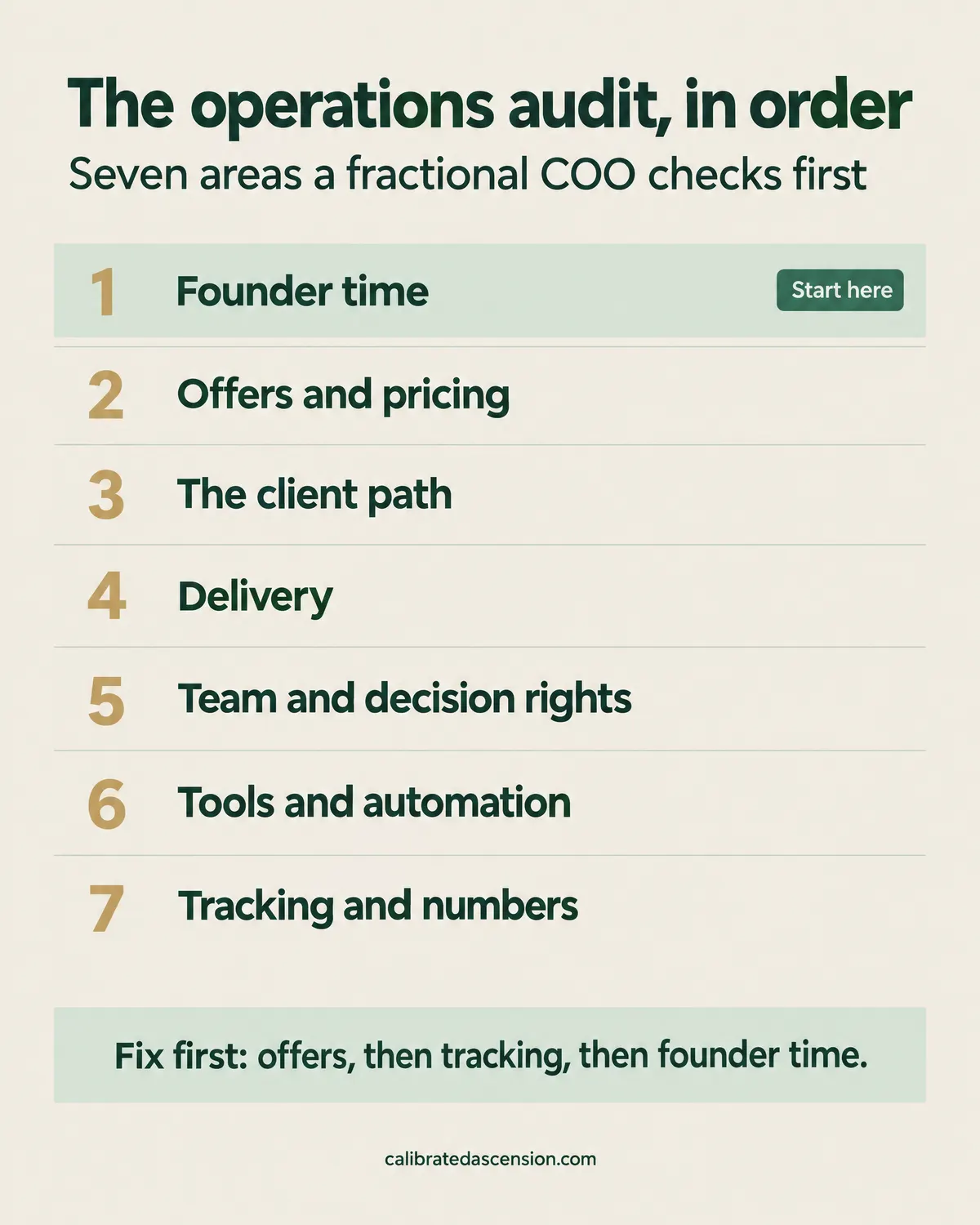
If the audit turns up more than you can handle, use this order. Fix anything in offers and pricing first, since every other area is organizing around it.
Then fix tracking, so you can see whether the rest of your fixes are working. Then work on founder time, taking back the hours that only exist because nothing else is in place.
If more than half the checks came back broken, read the signs you need a fractional COO. If the list feels heavy, that's normal.
Most of what you find will be symptoms of two or three root causes. If you'd rather have someone run it with you, that's the first phase of a fractional COO engagement, and the role itself is covered in what a fractional COO actually does.
The real audit

Every question on this checklist is a version of one question: where is the business leaning on you to stay upright? Your calendar answers it before anything else does. That's why the audit starts there.
Run it honestly and you'll know exactly where to place the next support, so the business can stand straight on its own and you can stop holding it up with your shoulders.
Common questions
What is included in an operations audit?
An operations audit reviews how the business actually runs against how it's supposed to run. For a service business that means the offers and pricing, the client path from lead to renewal, delivery, team roles and decision rights, tools and automations, tracking and numbers, and how the founder's time is really spent.
What are the steps of an operations audit?
Inventory what exists, map how work actually flows, compare it to how it should flow, rank the gaps by impact, then fix the highest-leverage ones first. The most common mistake is skipping the inventory and going straight to fixes, which means solving the problem you assumed instead of the one you have.
How long does an operations audit take?
A focused self-audit using a checklist like this one can be done in a few working sessions. A full audit with a fractional COO is usually the first phase of a longer engagement, since studying the business properly takes time before anything gets changed.
What is the difference between an operational audit and a financial audit?
A financial audit checks whether your numbers are accurate. An operational audit checks whether your business runs well: whether work flows cleanly, whether the right people own the right decisions, and whether effort turns into results. One looks at the record, the other at the machine producing it.
What should a COO check first?
The founder's calendar. How the founder actually spends their week shows where the business depends on them, which decisions have no other owner, and which work should be automated, delegated, or deleted. Almost every other finding in an audit traces back to that inventory.
End of post
Continue exploring
Want us to run this audit with you?
The marketing audit takes the same look from the outside, across offers, automation, and traffic, and hands you the prioritized list of what to fix first.
Book the marketing audit