
7 Signs Your Startup Actually Needs a Fractional COO
A two-minute self-score, the signs that say it's still too early, and which businesses are the best fit.

In this post
01
When a startup needs a fractional COO
You need a fractional COO when the business has outgrown the way you run it. The offer works, the revenue is real, and people want what you sell. What's breaking is the structure underneath: decisions, handoffs, tools, and a team that can't move without you.
Being busy isn't the signal. Every founder is busy.
The signal is that more of your effort no longer produces more of the result. You can usually feel that in your body before you can explain it on a spreadsheet: the tight jaw on Sunday night, the reflex to check Slack at a red light.
02
7 signs you need a fractional COO

Read these slowly and count how many are true right now, not how many were true last year.
- Everything still routes through you. Launches, client questions, approvals, hiring decisions. Your team can do the work, but they can't move without checking with you first, so your inbox becomes the speed limit of the whole company.
- Revenue is flat while your hours keep climbing. You're working more to stay in the same place. That's the clearest signal there is: effort has stopped converting into growth, which means the constraint moved from effort to structure.
- Delivery quality drops every time you add clients. Ten clients feel great. Twenty feel frantic. Thirty and something slips every week. The offer is fine. The system underneath it was built for a smaller business.
- You've hired help and you still redo the work. You brought on a VA or a coordinator and ended up checking everything twice. The problem usually isn't the person. There's no documented way the work gets done, so the standard lives only in your head.
- Every launch feels like the first one. Same scramble, same late nights, same things forgotten in the final week. Nothing from the last launch was captured, so nothing compounds.
- Your tools don't talk to each other. You pay for a stack of software every month and someone still copies data between tools by hand. Nobody is sure which system is the source of truth.
- You can't take a week off. Not without checking your phone every hour. The business can survive your absence for a day, maybe two, and you can feel the tension in your shoulders the whole time you're away.
03
Score yourself
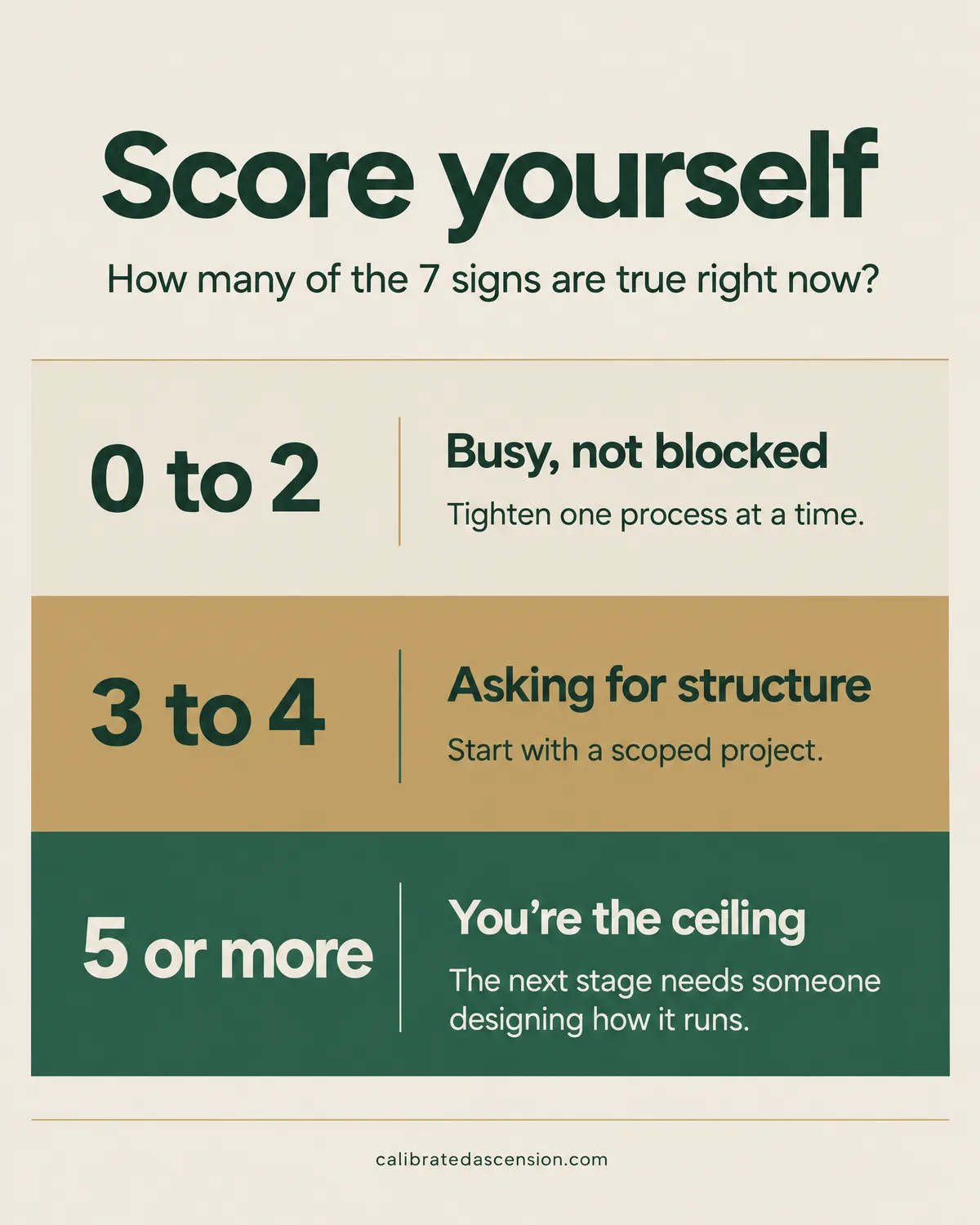
- 0 to 2 signs: you're busy, not blocked. Tighten one process at a time and revisit in a quarter.
- 3 to 4 signs: the business is asking for structure. A scoped project, like an operations audit or a delivery rebuild, is often the right first step.
- 5 or more: you're the ceiling. The next stage of growth needs someone designing how the business runs, and it probably can't be you.
Scoring high isn't a verdict on you as a founder. It usually means you built something that worked well enough to outgrow its own frame. That's a good problem, and it has a clear fix.
04
Signs it's still too early
This part matters as much as the list above. A fractional COO is the wrong hire if:
- You don't have an offer that sells consistently yet. Operations make a working business run better. They can't create demand that isn't there.
- Revenue isn't consistent yet. As a rough line, we look for around $20,000 a month or more before a retainer makes sense. Below that, the fee competes with things that will move the business faster.
- Your offers are still scattered. If you're selling four different things to four different people, a COO will make the scatter run very efficiently. Get coherent first.
If you're not sure which side of that line you're on, the leverage assessment will show you where the constraint actually sits.
05
Which businesses are the best fit
The best fit isn't an industry. It's a stage. The businesses that get the most from a fractional COO tend to share three things:
- Real revenue and a proven offer. Typically six- and seven-figure businesses, where the demand is established and the operations are lagging behind it.
- A team that is forming or formed. Contractors, a VA, a small core team. People who could own more if the structure let them.
- A founder who is still the bottleneck. The business depends on your attention more than it depends on your vision.
That includes early-stage startups past product fit, and it very much includes expert-led service businesses: coaching, consulting, agencies. Those have their own shape, which we cover in fractional COO for coaches and service businesses.
Fractional or full time?
For most startups and founder-led businesses, fractional comes first. A full-time COO costs $150,000 to $350,000 or more a year before equity and benefits, while fractional retainers in the market typically run $3,000 to $10,000 a month. More important than the price is the job itself.
Early on, the job is to design and install the operating system. That's project-shaped work, and it doesn't need a permanent seat.
Full time makes sense later, when the operating system exists and running it has become a full-time job of its own. For how engagements are usually scoped, see how a fractional COO contract is structured.
The real sign underneath all seven
Every sign on this list is the same sign wearing a different outfit: the business is standing on one leg, and that leg is you. It can hold for a while.
You can even look graceful doing it. But the smallest push, a sick week, a big launch, a key client leaving, and everything wobbles.
A fractional COO's job is to give the business its other leg. The right one builds a structure that lets the company stand on its own, so you can finally shift your weight, look up, and lead it forward.
Common questions
When should you hire a fractional COO?
When the business has outgrown the founder's capacity to run it, and the offers are clear enough to build around. The practical signal is that growth now depends on your personal attention: every launch, client question, and hire still routes through you, and adding effort no longer adds revenue.
Is it too early to hire a COO?
It's too early if you don't yet have an offer that sells consistently. Operations make a working business run better, so they can't rescue one that isn't working yet. As a rough line, we look for consistent revenue of around $20,000 a month or more before a retainer makes sense.
What types of companies are the best fit for a fractional COO?
Founder-led businesses with real revenue, a forming or formed team, and a founder who is still the bottleneck. That includes early-stage startups past product fit and established service businesses like coaching, consulting, and agencies in the six- and seven-figure range.
What is the difference between a fractional COO and a full-time COO?
A full-time COO is an executive hire who runs operations long term, at $150,000 to $350,000 or more a year before equity and benefits. A fractional COO does the same kind of work part time, usually to design and install the operating system, then hand it to the team.
What should I expect in the first 90 days with a fractional COO?
The first quarter usually moves in three phases: study how the business actually runs, build or fix the highest-leverage systems, and hand them to the team. By the end of it you should be able to name what now runs without you.
End of post
Continue exploring
Scored five or more?
That's where guessing gets expensive. The marketing audit shows where the structure is breaking across offers, automation, and traffic, and what to fix first.
Book the marketing audit